If you sell products and you are pricing up an online store, you have probably seen quotes anywhere from $2,000 to $50,000 and wondered what on earth the difference is. This guide breaks it down: what an e-commerce website actually costs in New Zealand in 2026, what moves the price, and what the ongoing costs look like once you are trading. We build online stores for NZ businesses, from theme-based Shopify launches to fully custom headless builds, so these are working numbers, not guesses.

The short answer
For most New Zealand small and medium retailers, a professionally built online store costs $5,000 to $20,000 + GST as a one-off build, with complex or fully custom builds running $25,000 to $50,000 and above. Once live, expect $200 to $500 a month in platform, hosting and payment costs before marketing. (These ranges reflect published 2026 NZ e-commerce rates, cross-checked against what we quote.)
As with any website, the price comes down to who builds it and what you are building.
Who builds it
| Who builds it | Typical NZ price | The trade-off |
|---|---|---|
| DIY on Shopify or Wix | Platform fees only (~$700+/year) | Cheapest entry, but your time does the work, and conversion details are easy to get wrong |
| Freelancer, theme setup | $2,000 to $8,000 | Good value for small catalogues; support and strategy vary |
| Studio, custom build | $10,000 to $30,000+ | Custom design, conversion strategy, integrations and support, built to grow revenue |
What you are building
| Store type | Typical NZ price (+ GST) | Timeline | Best for |
|---|---|---|---|
| Theme-based store, small catalogue | $5,000 to $12,000 | 6 to 8 weeks | First stores, under ~100 products |
| Custom-designed store | $12,000 to $30,000 | 8 to 12 weeks | Established brands that need to stand out and convert |
| Headless / complex build | $30,000 to $50,000+ | 10 to 16 weeks | Custom product experiences, wholesale logic, heavy integrations |
| Ongoing platform + payments | $200 to $500 / month | — | Every live store |
These bands sit alongside the general figures in our New Zealand website cost guide. The rest of this guide is about what makes e-commerce specifically different.
Why a store costs more than a brochure site
A standard business website has one conversion: get the visitor to call or enquire. An online store has to do the whole job itself. That means product pages that sell, a checkout that never fails, shipping rules that match what your couriers actually charge, GST handled correctly, inventory that stays in sync, and the email flows that recover abandoned carts. Each of those is real setup and testing work, and it is where the extra budget goes:
- Catalogue setup. Every product needs data, variants, pricing and images loaded and checked. A 40-product store and a 4,000-product store are different projects.
- Design that converts. Product photography presentation, trust signals, reviews and a fast path to checkout decide your conversion rate. A one percent improvement compounds on every visitor you ever pay for.
- Payments and shipping. NZD payments, Afterpay or Laybuy if your market expects it, and shipping zones that do not quietly lose you money on rural deliveries.
- Integrations. Accounting (Xero for most NZ stores), inventory, email marketing and analytics all need wiring up properly.
Choosing the platform
Most NZ stores should start with Shopify. It is not the cheapest subscription, but it removes whole categories of risk: hosting, security, checkout reliability and PCI compliance are handled, and the app ecosystem covers almost every need. WooCommerce makes sense if your business already runs on WordPress and you have someone to maintain it. A headless build, where Shopify runs the backend and a custom frontend handles the experience, is the top tier: it suits brands whose product genuinely needs a custom interface, like configurators or live previews.
The platform subscription is the smallest cost in the stack. What matters is that the build on top of it is done properly, which is the same point we make in our guide to template builders versus custom-coded websites: the tool matters less than what is built with it.
Real NZ store builds
Numbers mean more with proof behind them. Two of our e-commerce builds show the range:

Custom CMS · ticket platform for SD event
A custom ticket platform with its own CMS, e-commerce beyond what an off-the-shelf theme covers.
Read the case study →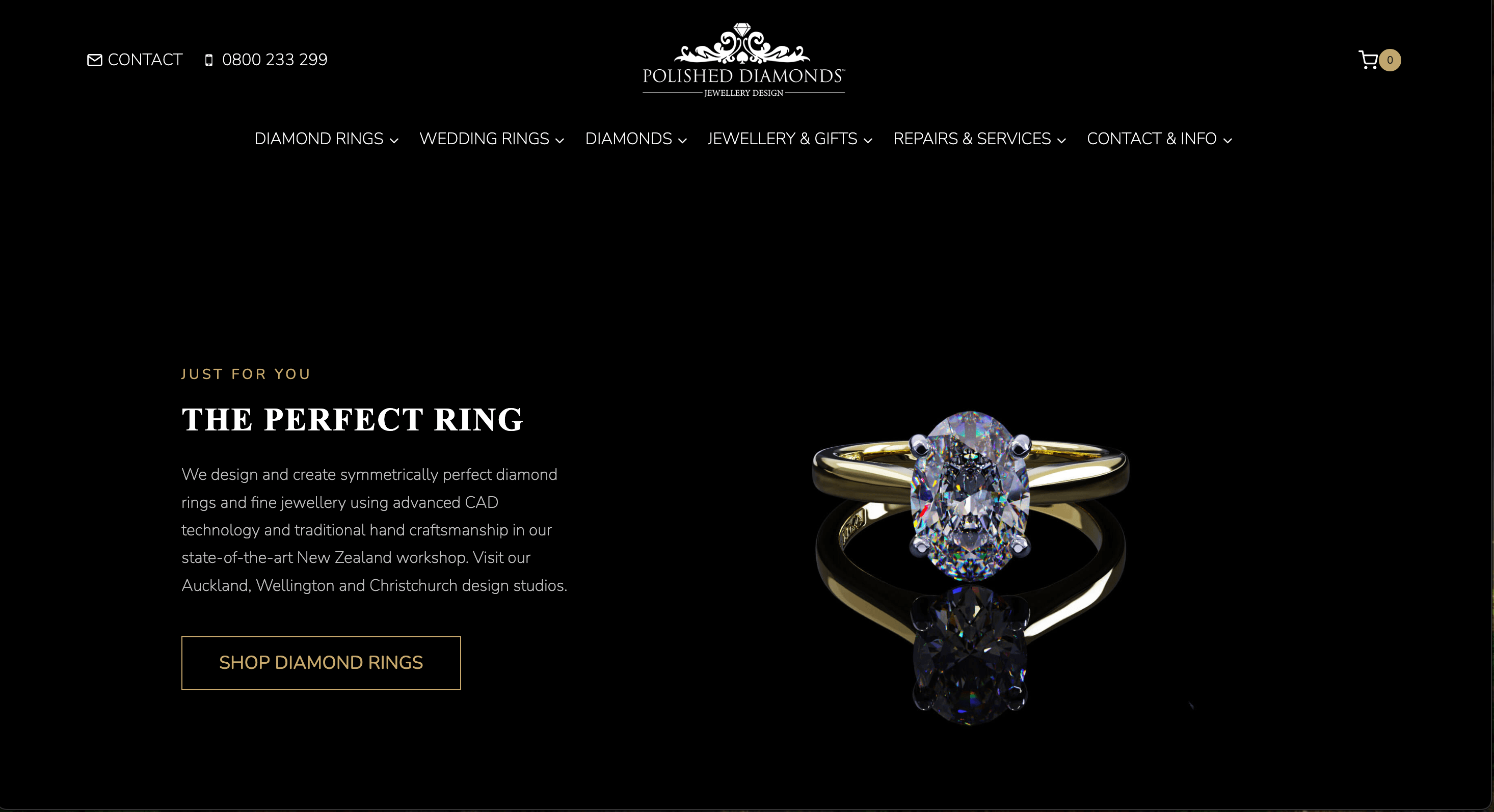
NZ custom jeweller · three showrooms, one elegant enquiry flow
An e-commerce build for a jeweller where trust and product presentation carry the sale.
Read the case study →The common thread: the budget went into the buying experience, not decoration. That is what separates a store that trades from a store that just exists.

The ongoing costs, honestly
The build is one-off, but a store has running costs a brochure site does not. Budget for:
- Platform: Shopify Basic is about NZ$56 a month; higher plans add features and lower transaction fees.
- Payments: roughly 2.7 to 3 percent per transaction plus a small fixed fee. This is a cost of sale, not overhead.
- Apps: reviews, email flows and subscriptions typically add $30 to $150 a month depending on the stack.
- Domain and email: $50 to $100 a year.
- Marketing: the store does not bring its own traffic. Most NZ stores pair organic SEO with Google Shopping and Meta ads to drive sales while rankings build.
All up, $200 to $500 a month is a realistic floor for a trading store. If a proposal shows $0 ongoing, something has been left out.
Where cheap store builds go wrong
The pattern we rebuild most often: a business buys a $2,000 store, loads the products themselves, and six months later has plenty of traffic reports and no sales. Almost always the money was spent making the store exist rather than making it convert. Slow product pages, no trust signals, shipping surprises at checkout and a generic theme that looks like a thousand other stores will quietly kill conversion, and no amount of ad spend fixes a leaky checkout.
There is a second version of the trap at the other end of the market. At many larger agencies an online store is sold by a salesperson on commission, then built by a production team you never meet. Scope gets padded because padding is profitable, and the person who understood your catalogue on the sales call is not the person building the checkout. We keep it direct: the people you talk to are the people building the store, so the budget goes into the parts that sell products. It is the same reason we publish our thinking on what websites should cost in the first place.
E-commerce website packages: what to budget, start to finish
A lot of NZ agencies sell online stores as tiered "e-commerce packages". The labels vary, but under the hood every package is pricing the same five things, so here is the honest price list for a store that actually trades:
- Build: $5,000 to $12,000 + GST for a theme-based store done properly; $12,000 to $30,000 for custom design; more for headless or heavy integrations.
- Content: product photography and descriptions, either supplied by you or budgeted as a line item.
- Launch marketing: an opening push of paid traffic so the store has sales data from week one.
- Ongoing: $200 to $500 a month across platform, payments and apps.
- Timeline: six to eight weeks for theme builds, longer for custom. Our website timeline guide covers what actually moves the schedule.
If your store also serves a local walk-in trade, tie it into your local presence the same way a service business would; our Auckland website cost guide covers how local search changes the equation.
The bottom line
An e-commerce website in New Zealand costs $5,000 to $20,000 plus GST for most small and medium retailers in 2026, more for custom and complex builds, plus a few hundred a month to run. Spend to match the catalogue and the ambition: a small range on a well-set-up theme is a fine start, and a growing brand earns a custom build when conversion gains outweigh the cost. Either way, insist on knowing where the budget goes and who is actually doing the work.
Our e-commerce web design service covers both ends of that range, and if you want a real number for your store, tell us what you sell and we will scope it with you.