Wix and Squarespace market themselves as the modern way to get a website, and agencies talk about custom code as if the difference were obvious. It usually is not explained, so let us actually explain it: what a template builder really is under the hood, where the bloat comes from, what custom code on a framework like Next.js does differently, and, because it is the worry that keeps people on builders, how you edit a custom site without touching code. We build custom sites for a living, so you know where we stand, but the technical facts below hold regardless of who is telling them.

The short answer
A template builder and a custom build produce the same thing: a website made of HTML, CSS and JavaScript, because that is all a website can be made of. The builder writes that code for you through a drag-and-drop layer, and the price of the convenience is everything that layer drags along: platform code your visitors download on every visit, a performance ceiling you cannot raise, a template look you share with thousands of sites, and a platform you can never leave with your site intact. A custom-coded site on a modern framework such as Next.js ships only what each page needs, which is why it is faster, ranks on its own merits and belongs to you outright.
For most businesses whose website has a job to do, custom wins. Builders keep a legitimate narrow lane, covered honestly at the end.
What a template builder actually is
Here is the part the marketing never says plainly. There is no such thing as a website that is not code. Wix, Squarespace and friends are not an alternative to code; they are a visual layer that generates it. You drag a block, the platform writes generic HTML, CSS and JavaScript underneath, one-size-fits-all code designed to survive anything any customer might drag anywhere.
That design goal is where the bloat comes from. The platform ships its runtime system to your visitors, not just your content: the code that powers the editor's flexibility travels with the site it built. Analyses of builder sites consistently find hundreds of kilobytes of platform JavaScript that cannot be removed, and request counts several times what an equivalent hand-built page makes, loaded whether or not you use the features they power.
Fairness requires a caveat, because this claim is often overstated: builder platforms have invested seriously in performance, and by 2026 a large share of builder sites pass Google's Core Web Vitals. The floor has genuinely risen. The point is the ceiling. On a builder, the platform decides how fast your site can possibly be, and when it is not fast enough, there is no one to fix it and nothing you can do. On a custom build, the ceiling is the developer's skill.
The comparison that matters
| Template builder | Custom-coded (Next.js or similar) | |
|---|---|---|
| What it is | A visual layer generating generic code | Code written for your site specifically |
| What visitors download | Your content + the platform's runtime | Only what each page needs |
| Performance | The floor is decent now; the ceiling is fixed | As fast as it is built to be |
| Design | A template thousands of sites share | Yours alone |
| SEO control | Partial: structure, schema and speed have platform limits | Total |
| Custom functionality | What the app store offers | Whatever the business needs |
| Ownership | You rent; Wix has no export at all | You own the code, host it anywhere |
| Cost shape | Low monthly forever, price rises with needs | One-off build, minimal hosting |
| Content edits | Built-in editor | CMS admin dashboard, covered below |
The ownership row deserves emphasis because almost nobody checks it before signing up. Wix provides no way to export your site; Squarespace exports basic text content only, with the design staying behind. Years of work on a builder is not an asset you hold, it is a subscription you continue. A custom site is standard code that moves with you.
What custom-coded means in 2026
The phrase can sound like handcrafted extravagance. In practice it means building on a modern framework, we use Next.js, where pages are rendered on the server and the browser receives lean, purpose-built output. The same stack runs some of the largest sites on the internet; applied to a business site, it produces pages that load near-instantly, carry exactly the structured data and page structure Google reads, and can grow whatever functionality the business needs, from booking flows to the custom product experiences a template cannot express.
That control is precisely what decides the local search results businesses live on, which is why our tradie builds lean so hard on it. Structure, schema and speed are the levers, and a builder only ever hands you part of each lever.
Wix vs a custom website, specifically
Wix is the comparison people actually search for, so it deserves its own paragraph rather than hiding inside "builders". Wix is the most capable of the drag-and-drop platforms and Wix Studio has narrowed the design gap, but the structural trade-offs above apply to it in full, and two of them apply hardest. First, lock-in: Wix offers no site export of any kind, so every hour you invest is an hour that stays on the platform. Second, cost shape: the plans a business actually needs sit around NZ$30 to NZ$60 a month and rise as you add features, which over five years quietly approaches the price of a modest custom build you would have owned outright.
The honest framing is this: Wix versus a custom website is not a features comparison, it is a rent-versus-own decision with a performance ceiling attached. If the site is a placeholder, rent. If the site is how customers find and choose you, own it.
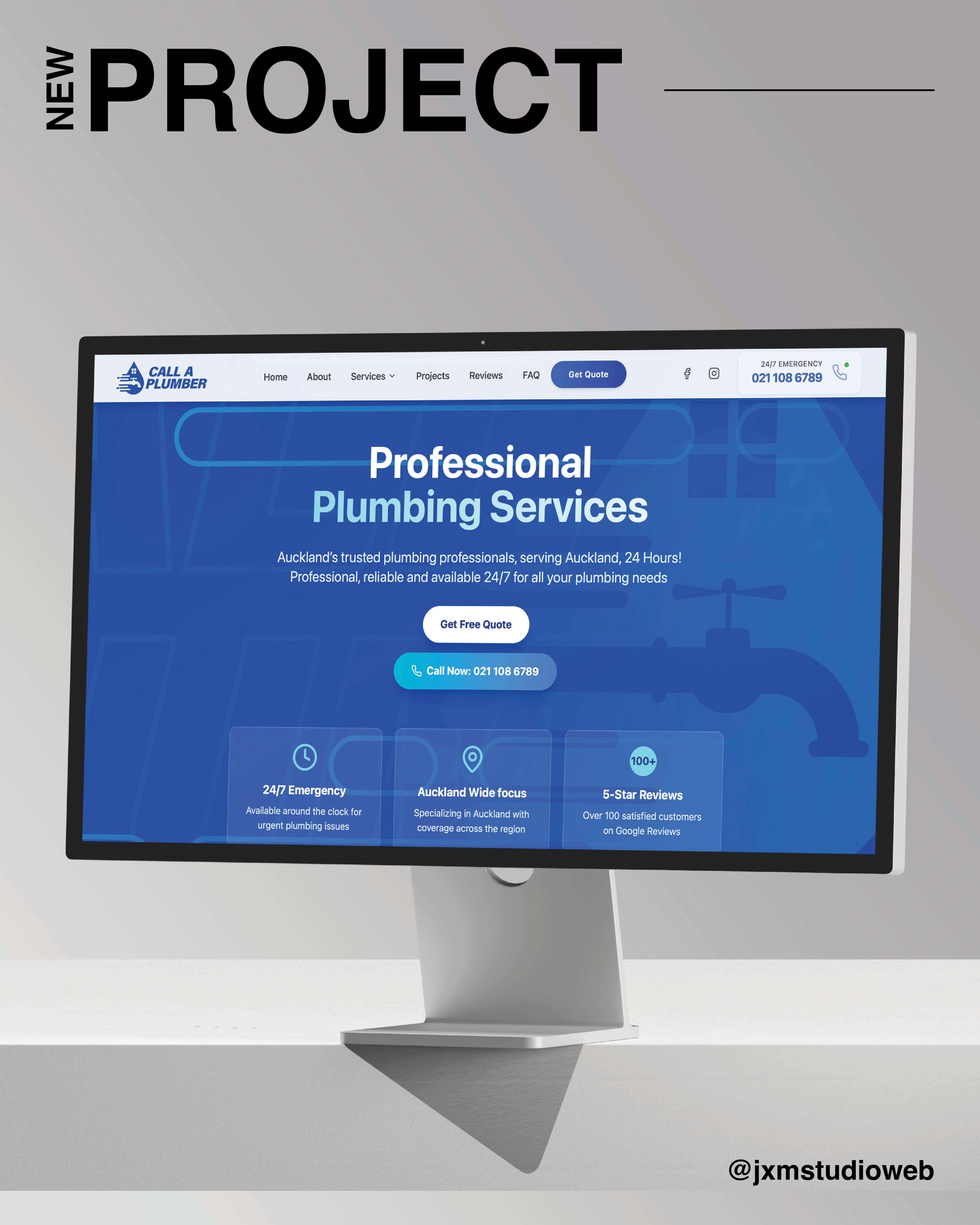
Multiple new enquiries · 4 weeks live
A custom build for an Auckland plumbing business, bespoke requirements included, live in four weeks and bringing in new enquiries.
Read the case study →"But I need to edit my own site"
This is the fear that keeps businesses on builders, so let us kill it properly: a custom-coded site does not mean calling a developer to fix a typo. Any good agency or developer hands over a CMS with the build, a private admin dashboard where you log in and edit your content: text, photos, prices, team members, case studies, blog posts. If a developer quotes you a custom site with no CMS, that is a corner being cut, and you should ask why.
Editing through a CMS is builder-easy, and in one way better: content and code are separate, so you can rewrite every word on the site and never break the layout, which is more than can be said for a drag-and-drop editor at midnight. The division of labour lands where it should: you own the words and pictures day to day, a developer touches structure when structure needs to change.

Where custom code has real limits
Leaning pro-custom does not require pretending it has no trade-offs, so briefly:
- Upfront cost is real. A custom build is thousands, not hundreds; our cost guide has the honest ranges.
- Structural changes need a developer. New page layouts or features are development work, not an afternoon of dragging blocks.
- Quality depends on who builds it. A bad custom site is worse than a good builder site; the framework does not save a careless build.
And builders keep a legitimate lane: something live this week on a tight budget, a placeholder while an idea proves itself, a hobby site where the tinkering is the point. Our DIY versus hiring a designer guide walks that decision from the owner's side, including the hours DIY really takes; and if you go the professional route, the build takes weeks, not months.
The bottom line
Template builders are code generators wearing a costume of simplicity: real convenience up front, paid for in platform bloat you cannot remove, a performance ceiling you cannot raise, and a site you can never take with you. Custom code on a modern framework flips every one of those, and the editing fear that keeps people on builders is solved by something every good developer includes anyway: a CMS that makes content yours without making code your problem.
If your website exists to bring in business, buy the version you own. Our web design service builds on Next.js with a CMS as standard, and we are happy to show you the admin dashboard before you commit to anything.