"How long will it take?" is the second question every client asks, right after price, and it gets the widest range of answers in the industry: same-day AI builders on one end, agencies quoting six months on the other. Both extremes are telling you something. This guide gives you the realistic 2026 timelines for New Zealand builds, what actually happens week by week, and the one factor that blows out more launch dates than everything else combined. We run these projects every week, so these are the schedules we actually hit.

The short answer
Most professional business websites in New Zealand take three to four weeks from kickoff to live. Bigger builds scale from there:
| Project type | Realistic timeline | What stretches it |
|---|---|---|
| Landing page / one-pager | 1 to 2 weeks | Copy approvals |
| Standard business site | 3 to 4 weeks | Content gathering |
| Custom site (booking, multi-service) | 4 to 7 weeks | Integrations, rounds of feedback |
| E-commerce store | 6 to 10 weeks | Catalogue size, payment and shipping setup |
| Complex / headless build | 10 to 16 weeks | Custom functionality, integrations |
Those bands match what we publish in our website cost guide and e-commerce cost guide, because time and price move together: both are measures of how much has to be designed, built and tested.
What the weeks are actually spent on
A three-to-four week build is not three weeks of typing. Here is where the time goes on a standard business site:
- Week 1: foundations. Kickoff, sitemap, content collection, and the search structure: which services get pages, which suburbs, what people actually search for. Decisions made here set the ceiling on everything after; it is the thinking we describe in our tradie website guide, applied to any local business.
- Weeks 2 to 3: design and build. Homepage design first for direction, then the full build: pages, mobile layouts, speed work, schema markup, forms wired to your inbox.
- Week 3 to 4: content in, test, launch. Real copy and photos in place, everything tested on real phones, redirects from any old site, analytics on, live.
E-commerce adds catalogue loading, payment and shipping configuration and checkout testing on top, which is what pushes stores to six-plus weeks.
The thing that actually delays websites
It is content. Not design, not development, content. The build side of a project runs on schedule because the builder controls it. Photos of your work, the services list, the approval from the co-owner who is on holiday: those depend on you, and they are where launch dates quietly slip from four weeks to four months.
The fix is boring and works: gather content before kickoff, not during. Job photos off your phone, a bullet list per service, your Google reviews, and access to your domain registrar. That last one deserves its own sentence: find out where your domain is registered before the project starts, because recovering access to a domain someone's ex-web-guy registered in 2016 has delayed more launches than any design decision ever has.
Too fast and too slow are both warnings
Too fast: a full business site delivered in days means a template with your logo on it, no search structure and thin content. It is a real product with a real market; just know that is what is being sold. Our builder versus designer comparison covers when that trade is acceptable and when it costs you.
Too slow: three to six months for a standard business site usually is not build time, it is queue time. At many larger agencies your project waits behind others and passes through a handoff chain: salesperson, account manager, designer, an offshore team overnight. Every handoff adds elapsed days and blurs the brief a little more. It is worth asking any agency two questions: what is the elapsed time actually spent on, and who is doing the work? Working directly with the people building your site compresses most of that away, which is a large part of how three-to-four week launches stay realistic.

Builds that ran to schedule
Two of ours, at different scales:
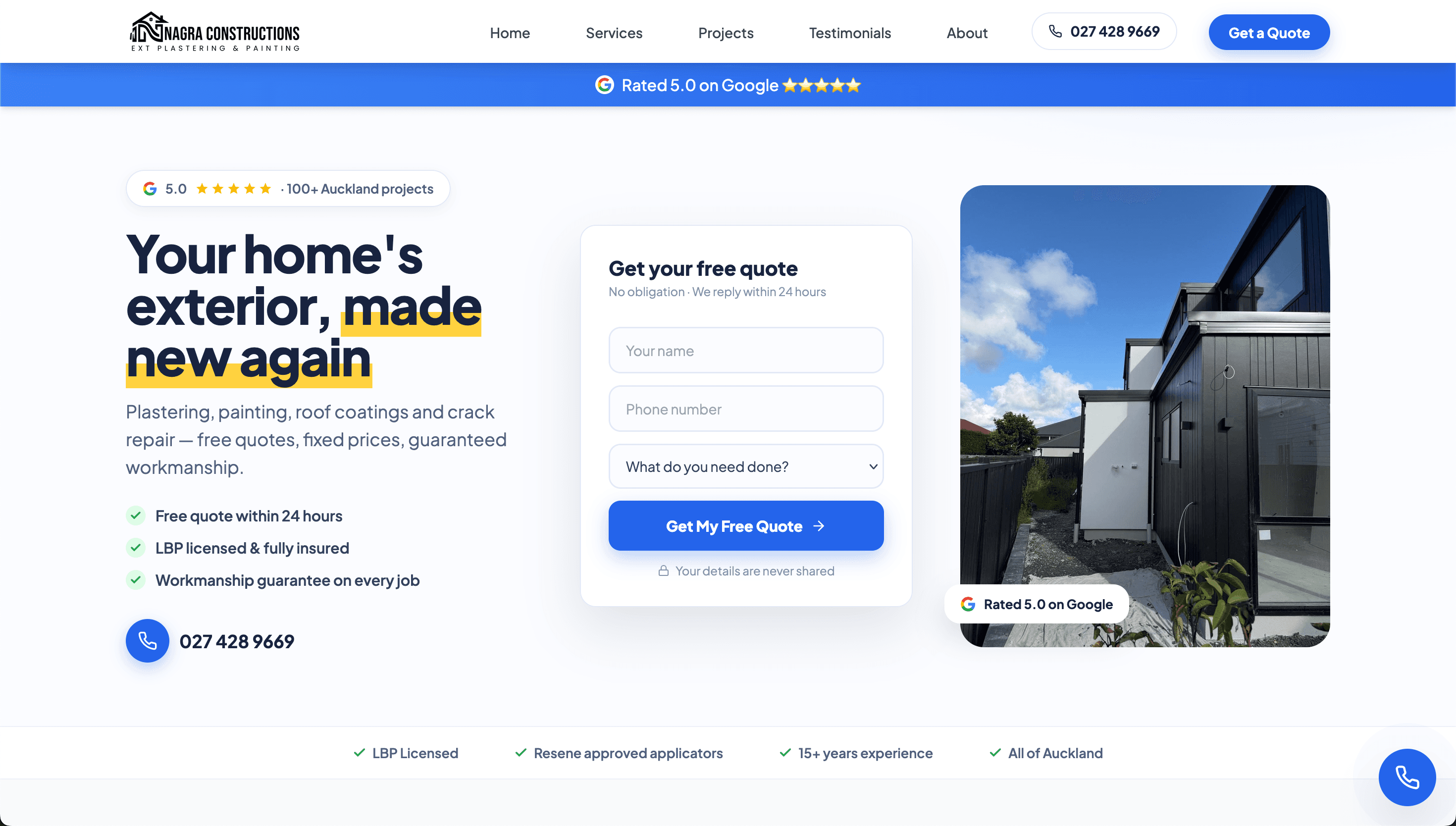
Auckland builder · positioned to win higher-value renovation enquiries
A construction company site built to win local work.
Read the case study →
Custom CMS · ticket platform for SD event
An e-commerce build, where catalogue and checkout work set the timeline.
Read the case study →Different projects, same pattern: the schedule held because content was sorted early and decisions had one owner on each side.
When you genuinely need it faster
Sometimes the deadline is real: a business launching, a trade show booked, an old site that just died. The honest way to compress a timeline is to shrink the scope, not the quality. We phase it: a sharp one-page site with your core offer, contact details and local SEO basics can go live in about a week, and the full site follows behind it at the normal pace. You are findable and credible for the event that mattered, and nothing built in the rush is thrown away.
What does not work is compressing a full build by skipping the foundations. Cutting the search structure to save a week costs months of rankings on the other side, which is a bad trade in every case we have seen.
Redesigns run on the same clock
A redesign feels like it should be faster than a new build, and usually it is not. The design and build work is the same, and two tasks are added: auditing what the old site ranks for so the new one does not lose it, and redirecting every old address to its new home. Skipping that step is how businesses launch a beautiful new site and watch their Google traffic fall off a cliff the same week. Budget three to five weeks for a standard redesign, and treat any quote that ignores redirects as a warning sign.
Launch is the start, not the finish
One honest expectation to set: the site being live does not mean the site is ranking. Google indexes a new site within days, but earning positions for competitive searches takes months of gradual gains, faster in small markets, slower in contested ones like Auckland. The structure built during those first weeks decides the ceiling. If you need enquiries before rankings arrive, paid ads bridge the gap from day one, landing on a site that is built to convert them.
How to be the client who launches on time
- Gather photos, services and reviews before kickoff.
- Confirm domain registrar access this week, not launch week.
- Nominate one decision-maker for feedback rounds.
- Give feedback in batches, not one thought per day.
- Trust the process on the search structure; it is the part that pays the longest.
The bottom line
A professional business website in New Zealand takes three to four weeks when content is ready, six to ten for e-commerce, and the honest answer to "can it go faster?" is: yes, if you narrow the scope, and no, if you want the structure that makes it findable. Be suspicious of same-week full builds and of quarter-long timelines in equal measure, and put your energy into content, because that is the part of the schedule you control.
Want a firm date for your project? Tell us what you need and when, and we will map the schedule with you before anything is signed. Our web design service runs on fixed timelines agreed up front.