Most plumbing businesses are built on word of mouth, and word of mouth has a ceiling. It cannot reach the person three suburbs over with water pouring through their ceiling, searching "emergency plumber near me" and calling the first name that looks trustworthy. This guide covers what a proper plumbing website costs in New Zealand and Australia in 2026, what it needs to include, and how it actually turns searches into booked jobs. We build websites for plumbers and other trades all the time, including the two real examples further down, so this is what works in practice, not theory.

The short answer
A professional plumbing website costs $4,000 to $8,000 + GST in New Zealand, or A$4,000 to A$8,000 + GST in Australia, for a sole operator or small crew. Multi-region firms that want online booking sit at $8,000 to $12,000. Hosting and a domain run about $40 to $60 a month. (Ranges reflect published 2026 NZ and Australian web design rates, cross-checked against what we quote.)
| Build type | NZ price (+ GST) | AU price (+ GST) | Best for |
|---|---|---|---|
| DIY builder site | ~$300 to $600 / year | ~A$300 to A$600 / year | A placeholder while you get started |
| Standard plumbing site | $4,000 to $8,000 | A$4,000 to A$8,000 | Sole traders and small crews chasing local jobs |
| Multi-region / booking build | $8,000 to $12,000 | A$8,000 to A$12,000 | Firms covering several regions or taking online bookings |
| Hosting + domain | $40 to $60 / month | A$40 to A$100 / month | Every live site |
These sit inside the bands from our New Zealand website cost guide and our broader guide to tradie websites. What makes plumbing different from other trades is the mix of customers, and it changes how the site should be built.
Two kinds of customers, one website
Plumbing demand splits cleanly in two, and a good plumbing website serves both without getting in either's way.
Emergency work is a burst pipe at 9pm, a blocked drain before guests arrive, a hot water cylinder that died overnight. This customer is on a phone, stressed, and will call the first plumber who looks legitimate and answers. For them, the site needs three things: a phone number that dials in one tap, proof you are real (reviews, licence, photos), and confirmation you serve their suburb. Every second of load time and every extra click loses calls.
Planned work is a bathroom renovation, a cylinder upgrade, a new build. This customer is comparing. They read your service pages, look at finished jobs, check reviews against the other two plumbers in their shortlist, and often visit twice before contacting anyone. For them, the site needs depth: detailed service pages, photos of comparable jobs, and an easy way to request a quote without a phone call.
A one-page site fails both. There is nowhere for the emergency customer to confirm you cover their area, and nothing for the renovation customer to compare. That is the core argument for a properly structured build.
Plumber website design that gets the phone ringing
The features that earn their keep on a plumbing site, in rough order of importance:
- Click-to-call, always visible. A sticky button on mobile. Nobody with water on the floor is filling in a form.
- A page per service. Blocked drains, hot water, gas fitting, backflow, renovations, maintenance. Each page ranks for its own searches and answers its own questions.
- Pages for the suburbs you serve. When someone searches "plumber Papakura" or "blocked drain Footscray", Google looks for a page that answers that exact search. Suburb pages are how a two-van outfit outranks a franchise where it matters.
- Real job photos. The cylinder install, the finished bathroom, the van outside a job. Proof beats polish.
- Reviews and credentials. Pull Google reviews onto the site, show your certifying or licensed plumber status, name your years on the tools.
- Honest pricing signals. Call-out fee, from-prices, or a clear quote promise. Certainty converts stressed customers.
- Fast mobile loading. Most plumbing searches happen on a phone. A site that takes five seconds to appear has already lost the call.
Real plumbing sites we've built
Two builds that show what the numbers above buy:
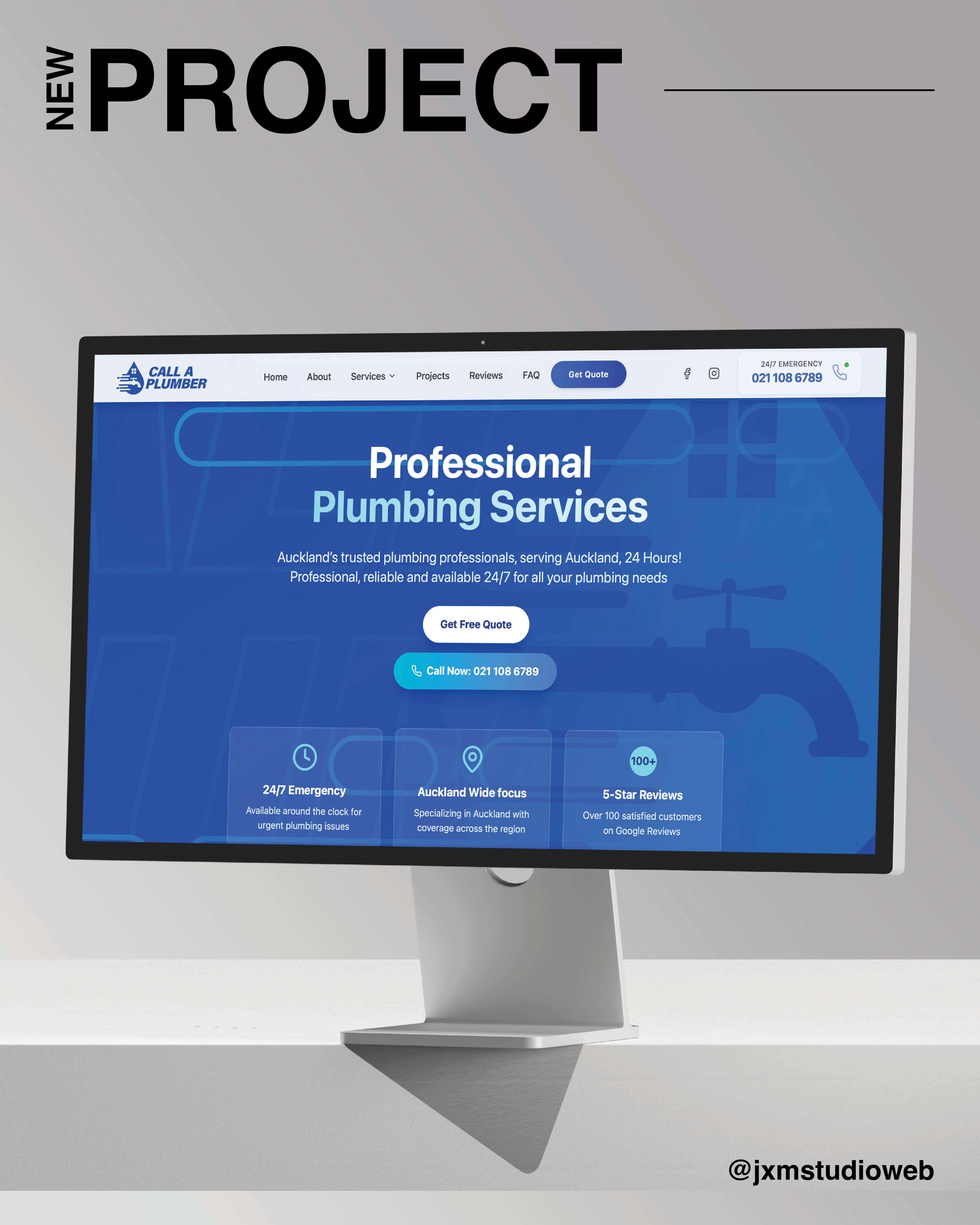
Multiple new enquiries · 4 weeks live
An Auckland plumbing company site with booking built in. Multiple new enquiries within four weeks of going live.
Read the case study →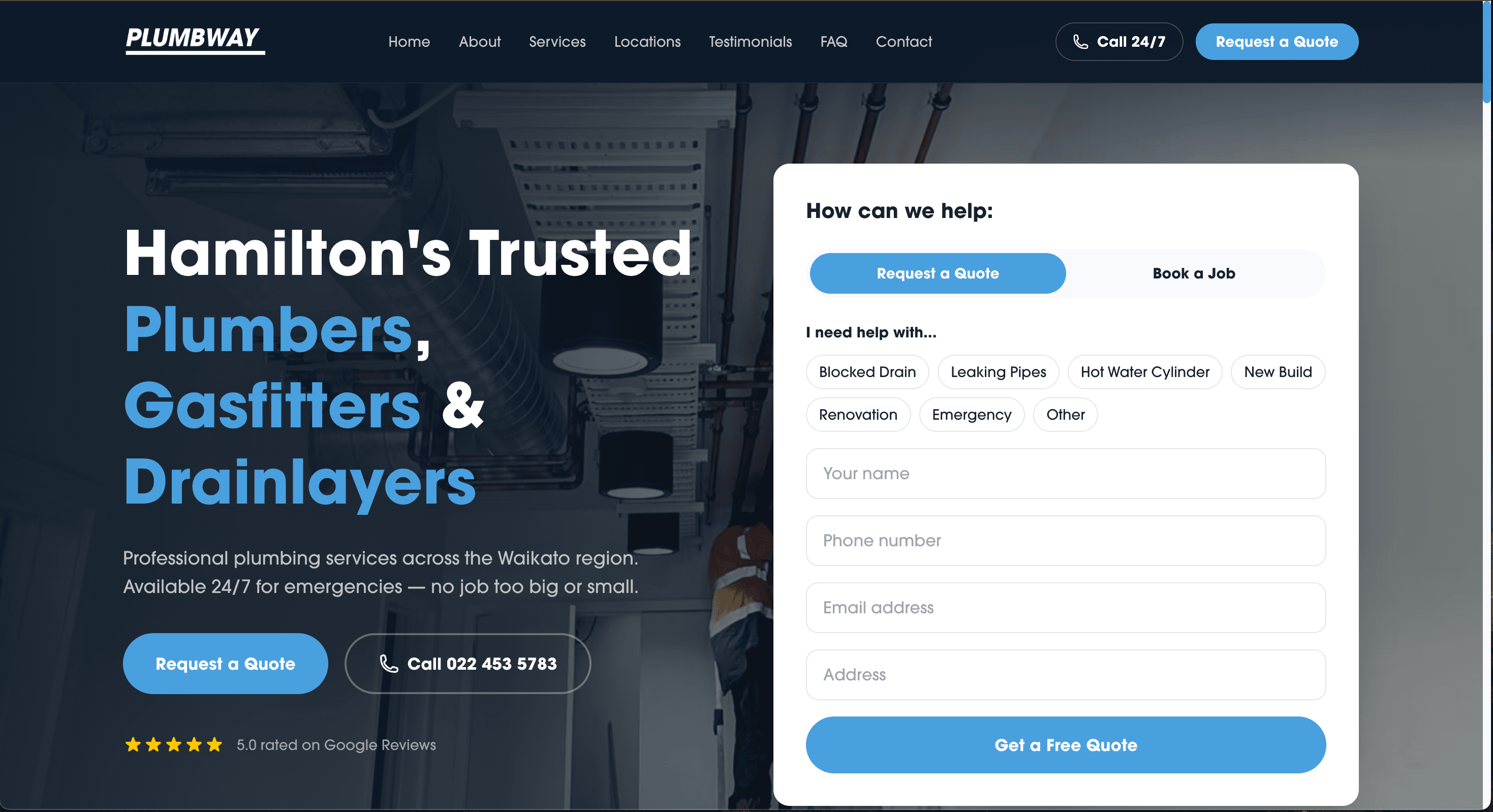
Hamilton plumber · built to turn local searches into booked jobs
A Hamilton plumber built around local search across the Waikato, with tap-to-call paths for urgent jobs.
Read the case study →Neither wins on decoration. They win because every page is structured for a search a customer actually makes, and because calling or booking takes one tap.
How a plumbing website actually brings in leads
There is no magic here, just mechanics. A plumbing site generates leads when three layers line up:
- It ranks for real searches. Service pages catch "hot water cylinder replacement", suburb pages catch "plumber + your suburb", and LocalBusiness schema tells Google exactly who and where you are. More pages that match more searches means more chances to be found.
- It pairs with your Google Business Profile. The profile gets you into the map pack; the website ranks for everything the map cannot, and gives people somewhere to verify you. Same name, same number, same service areas on both, and reviews feeding both. One without the other is half a presence.
- It converts the visit. One-tap calling for urgent jobs, a short booking or quote form for planned work, and proof (photos, reviews, credentials) doing the trust work before you ever pick up.
Once those foundations rank, Google Ads become a tap you can turn on when the schedule goes quiet, and they convert far better landing on a site built this way.
The cheap-site trap
The plumbing industry is full of $500 template sites that have never generated a call. The pattern is predictable: a builder site or bargain freelancer job goes up, it looks fine on a business card, a year passes, nothing happens, and the owner concludes websites do not work. Meanwhile a competitor with service pages and suburb pages takes the emergency call-outs in their own street.
Template builders cap what is possible: generic code you cannot tune, limited control over the local signals Google reads, and no real ownership. We cover when DIY makes sense in our website builder versus web designer guide. For a trade that lives on "near me" searches, the answer is usually not now.
The other thing to watch is who you are actually buying from. At some larger digital agencies, the person selling you the site has never built one; your job passes from salesperson to account manager to a production queue, and each handoff adds margin and loses detail. Two questions cut through any quote: who is building this, and do I own it when it is done? With us the answer is the people you talk to, and yes.
What to budget, start to finish
- Build: $4,000 to $8,000 + GST (A$4,000 to A$8,000 in Australia) for most plumbing sites, including service pages, suburb pages, schema and Google Business Profile setup.
- Content: your services list, service areas and job photos; we write the copy.
- Ongoing: roughly $40 to $60 a month for hosting and domain, no forced retainers. Our website maintenance cost guide breaks down the ongoing numbers.
- Timeline: live in three to four weeks; the website timeline guide covers what moves the schedule.
- Later: more suburb pages as you expand, and ads for immediate leads while rankings build.
You deal directly with the people building the site and own it outright at the end. That is the model our tradie web design service runs on, for plumbers on both sides of the Tasman.
The bottom line
A plumbing website done properly costs $4,000 to $8,000 plus GST in New Zealand or A$4,000 to A$8,000 in Australia, and the difference between that and a cheap template is not how it looks. It is whether the phone rings. Build for both customers: one-tap calling and instant trust for emergencies, depth and proof for renovations. Structure every page around a search someone actually makes, pair it with your Google Business Profile, and the site becomes what it should be: your best source of new work after word of mouth.
If you want a straight answer for your plumbing business, tell us your services and your patch.