Australian tradies pay some of the highest costs in the world to get work: lead platform fees on every job, ad clicks that cost more than a callout, and franchise systems that take a cut for the brand on the ute. Meanwhile the customers are right there, searching "plumber Werribee" and "electrician near me" every single day. This guide covers what a tradie website costs in Australia in 2026 and how it becomes the channel you own: no per-lead fee, no shared enquiry, no platform rules. We build sites for trades across Australia and New Zealand, including the Melbourne builds below, so this is field-tested.
The short answer
A professional tradie website in Australia costs A$4,000 to A$8,000 + GST for most sole traders and small crews, and A$8,000 to A$12,000 for multi-service or multi-region businesses that want booking. Hosting and a domain run about A$40 to A$100 a month. (Ranges reflect published 2026 Australian web design rates, cross-checked against what we quote.)
| Build type | Typical AU price (+ GST) | Timeline | Best for |
|---|---|---|---|
| DIY builder site | ~A$300 to A$600 / year | Your weekends | A placeholder while you get started |
| Standard trade site | A$4,000 to A$8,000 | 3 to 4 weeks | Sole traders and small crews chasing local jobs |
| Multi-service / booking build | A$8,000 to A$12,000 | 4 to 7 weeks | Firms with several trades, regions or booking |
| Hosting + domain | A$40 to A$100 / month | — | Every live site |
These match the wider bands in our Melbourne website cost guide. If you are on the NZ side of the Tasman, the NZ tradie website guide runs the same numbers in NZ dollars.
Renting leads versus owning them
Most Australian tradies have done the maths on lead platforms at some point. hipages, Airtasker, ServiceSeeking and the rest do deliver enquiries, but read the terms of the deal: you pay per lead or per month, the same enquiry is sold to several competitors, you compete on speed and price against them, and the platform owns the customer relationship. When fees rise or rules change, there is nothing you can do about it. It is renting.
A website that ranks in your suburbs is the opposite deal. The customer searched, found you specifically, read your reviews and called. No fee per lead, no competitor copied in, no algorithm to appease, and every job it wins this year it can win again next year. The platforms are fine for filling a quiet week. The site is the asset, and it compounds.
What gets an Australian tradie found on Google
Google's local results reward one thing above all: pages that answer the exact search. The structure that wins, trade after trade:
- A page per service. "Switchboard upgrades", "blocked drains", "kitchen renovations". Each catches its own searches and answers its own questions.
- A page per suburb or region. When someone searches "carpenter Footscray" or "plumber Ipswich", a generic "we service all of Melbourne" line competes for nothing. A proper page for each area competes for all of it. This is the single biggest gap on most tradie sites.
- Click-to-call, always on screen. Urgent jobs are won on the phone, from a phone.
- Real job photos and reviews. Finished decks, new boards, before and afters, pulled-in Google reviews. Proof is the whole sale to a stranger.
- Licence details up front. Australian customers are trained to check. Show your licence number, insurance and associations before they ask.
- Speed on mobile. Most trade searches happen on a phone, and slow sites lose the call before they load.
- LocalBusiness schema and a matched Google Business Profile. The profile wins the map pack, the site wins everything else, and matching details tie the two together in Google's eyes.
We went deeper on the plumbing and electrical versions of this playbook in websites for plumbers and websites for electricians; the structure holds for every trade.
How wide should your suburb net go?
A common question from Australian tradies: how many area pages, and how far out? The honest answer is to build where you would genuinely take a job tomorrow. For most metro trades that is a 20 to 40 minute run: eight to fifteen suburbs, each with a real page, not a find-and-replace clone. Google is good at spotting fifty near-identical pages, and thin pages can hurt more than help. Start with the suburbs where you already work, where your reviews mention street names and your photos show real jobs, then add the areas you want more of, one properly written page at a time. A regional tradie flips the logic: fewer, bigger pages per town, each deep enough to own that town's searches outright.
Real Australian builds
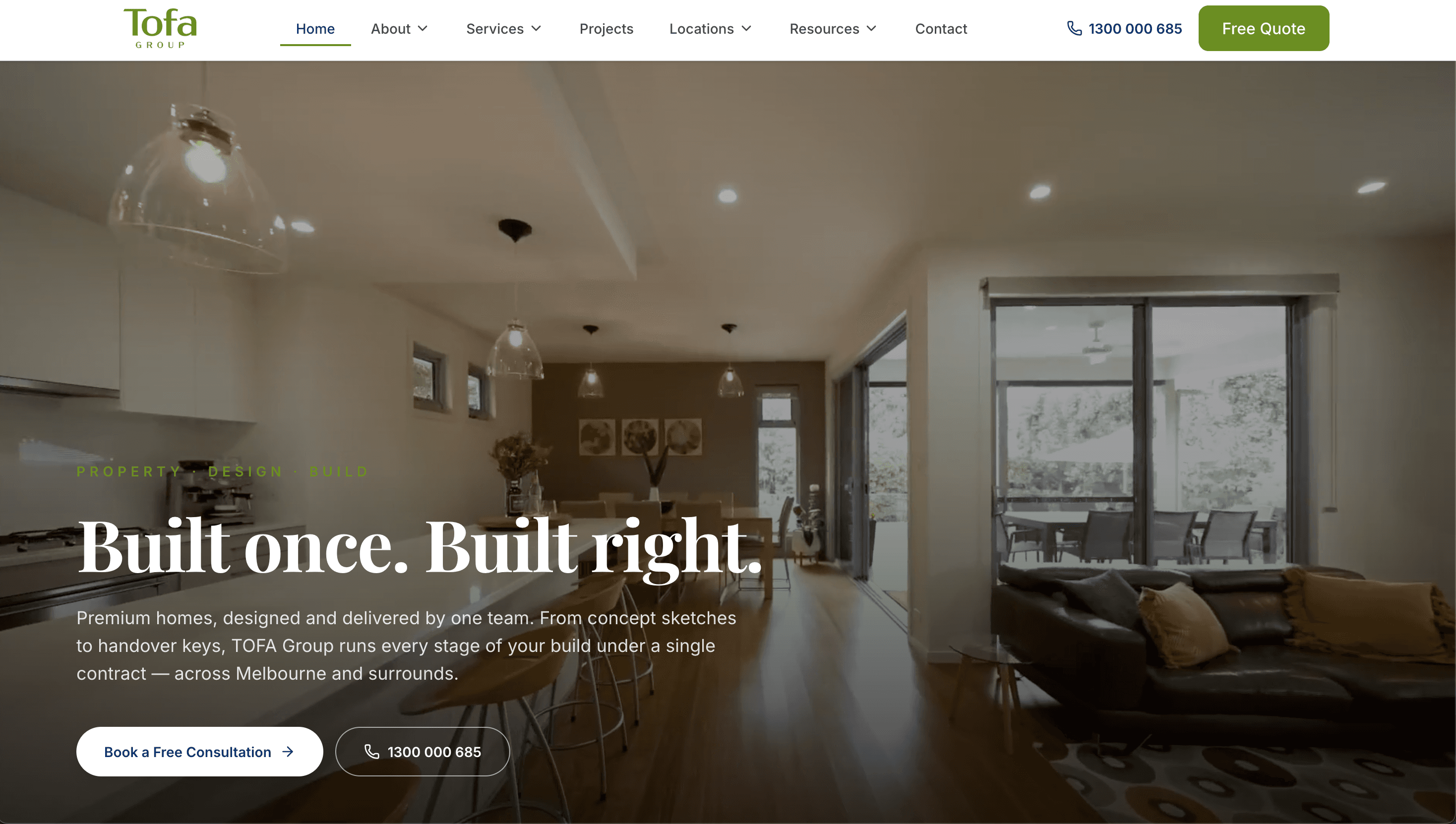
Custom home builder · one fixed-price contract, design to handover
A Melbourne custom home builder working across the city's west. The site makes their fixed-price, all-in-one model clear and reassuring for families.
Read the case study →
Sports flooring specialists · quote requests across four states
A specialist trade business servicing gyms, stadiums and schools across SA, VIC, NSW and the ACT. Built to read as the specialist, not a generalist.
Read the case study →Two very different trades, same underlying playbook: pages structured around what customers search, proof everywhere, and a clear next step on every screen.
The traps to avoid
The template special. A few hundred dollars a year buys a builder site that looks passable and ranks for nothing, because the platform's generic code and one-size structure cannot carry the service-and-suburb depth local rankings require. Our template builders versus custom code guide covers the technical reasons. For a business bought on "near me" searches, it is the wrong tool.
The package chain. Some large digital marketing outfits sell tradies bundled "website plus SEO plus ads" packages through commissioned salespeople, then route the actual work through account managers to production teams offshore. Each handoff adds margin, and the person who understood your business is not the person building your site. Before signing anything, ask who exactly does the work and whether you own the site and domain outright if you leave. (With us: the people you talk to, and yes, always.)
Splitting yourself across domains. One strong site with real pages per region beats three thin ones. Reviews, links and authority compound on one domain; they dilute across several.
What to budget, start to finish
- Build: A$4,000 to A$8,000 + GST for most trade sites, including service pages, suburb pages, schema and Google Business Profile setup.
- Content: your services, areas, licence details and job photos; we write the copy.
- Ongoing: about A$40 to A$100 a month for hosting and domain, no forced retainers. Our website maintenance cost guide breaks down what ongoing costs are legitimate and what is padding.
- Later: Google Ads as a tap for quiet months, and more suburb pages as you expand your run.
- Timeline: live in three to four weeks for most trades.
We work with Australian tradies remotely the same way we work locally: directly, with the people building the site. Our Melbourne web design page and tradie web design service cover how that works.
The bottom line
A tradie website in Australia costs A$4,000 to A$8,000 plus GST done properly, which is a few months of lead-platform fees for many trades, except this channel is yours. Structure it around the searches customers make (service pages, suburb pages), load it with proof (photos, reviews, licence), keep calling effortless, and pair it with your Google Business Profile. Do that and the site stops being a business card and starts being the steadiest source of work you have, in every suburb you want more of.
If you want a straight answer for your trade and your patch, tell us what you do and where you work.