Electricians have a quieter version of the problem plumbers have. Less midnight-emergency, more considered purchase: switchboard upgrades, rewires, EV chargers, new builds, commercial fit-outs. Jobs worth thousands, won by whichever sparkie the customer finds and trusts first. This guide covers what an electrical business website costs in New Zealand and Australia in 2026, and what separates a site that wins quoted work from a business-card brochure. We build websites for electricians and other trades constantly, including one further down that climbed to #2 on Google for its market, so this is practice, not theory.
The short answer
A professional electrician website costs $4,000 to $8,000 + GST in New Zealand, or A$4,000 to A$8,000 + GST in Australia. Multi-region firms or those wanting online booking sit at $8,000 to $12,000, and hosting runs $40 to $60 a month. (Ranges reflect published 2026 NZ and Australian web design rates, cross-checked against what we quote.)
| Build type | NZ price (+ GST) | AU price (+ GST) | Best for |
|---|---|---|---|
| DIY builder site | ~$300 to $600 / year | ~A$300 to A$600 / year | A placeholder in your first year |
| Standard electrical site | $4,000 to $8,000 | A$4,000 to A$8,000 | Sole traders and small crews winning local work |
| Multi-region / booking build | $8,000 to $12,000 | A$8,000 to A$12,000 | Firms with several regions, teams or booking |
| Hosting + domain | $40 to $60 / month | A$40 to A$100 / month | Every live site |
The bands match our tradie website guide and the wider New Zealand website cost guide. What changes for electricians is the buying behaviour: more research, more comparison, higher job values. The site has to be built for that.
Electrical work is quoted work, and that changes the site
A plumber's website lives and dies on the emergency call. An electrician's mostly does not. Outside of faults and power loss, your customers are planning: they want a switchboard upgraded before it trips again, a charger for the new EV, downlights through the living areas, a garage converted, a house rewired before sale. They search, shortlist two or three sparkies, compare, and contact the one who looks most capable.
That means an electrical site wins on depth and proof more than speed to dial:
- A page per service. Switchboard upgrades, rewiring, EV charger installation, lighting design, heat pump and hot water wiring, new builds, commercial. Each ranks for its own searches and pre-answers the customer's questions, including rough pricing.
- Before and after photos. Nothing sells a switchboard upgrade like the old scorched board next to the new one. Real photos out-convert any stock image.
- Registration and safety credentials, up front. Registered or licensed status, years in trade, guarantees. Electrical work is the trade where customers actively worry about cowboys, so proof of legitimacy does heavy lifting.
- A quote path with no friction. A short form (job type, suburb, photos optional) beside a click-to-call button. Planned-work customers often prefer writing to calling, especially after hours.
- Suburb pages. "Electrician + suburb" is still how most local searches happen, and a page per area is how you show up for them.
Faults and urgent call-outs still matter, and the site should keep one-tap calling visible for them. But if your site only says "24/7 call-outs", you are invisible for every quoted job in your area.
How the rankings actually work
When someone searches "EV charger installation" or "electrician Henderson", Google looks for pages that answer that specific search, backed by signals that the business is real and local: LocalBusiness schema, a claimed Google Business Profile with matching details, reviews that mention your suburbs. A site with one generic page competes for almost nothing. A site with a page per service and per area competes for all of it. The mechanics are the same ones we lay out in the tradie website guide, and they are the reason a two-person outfit can outrank a national franchise in its own suburbs.
The recurring work: landlords, property managers and small commercial
One more thing an electrical site should chase that a plumber's usually does not: recurring clients. Property managers need compliance work, smoke alarm checks and fault call-outs across whole rent rolls. Small commercial sites need maintenance, test and tag, and fit-out wiring. Body corporates need a sparkie they can name in a newsletter. These clients are worth many jobs a year each, and they choose differently: less impulse, more vetting. A dedicated page speaking to them (response times, compliance paperwork, invoicing that suits a property manager) is often the highest-return page on the site, because one enquiry from it can fill a calendar for years. Most electrician websites do not have one, which is exactly why yours should.
A real electrical build
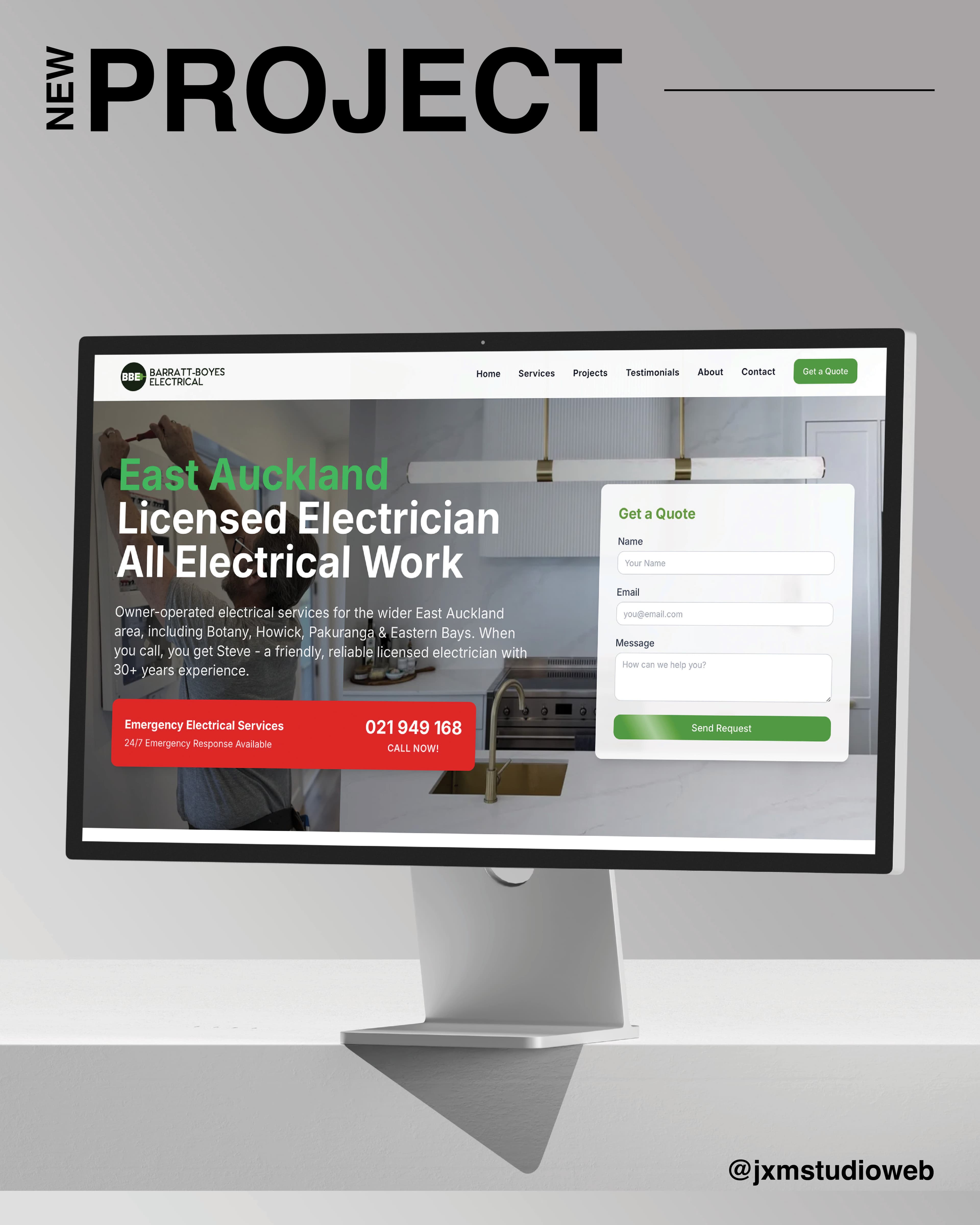
Ranking #2 on Google · bold new design live
A ground-up redesign for an Auckland electrical firm: bold design, easy booking, real job photos. The SEO foundations took it to #2 on Google.
Read the case study →The before and after gallery on that project tells the story better than any pitch: same business, same skills, completely different result once the site was structured around what customers search for.
The traps: template sites and agency chains
The failure modes for electricians are the same two we see across the trades.
The first is the $500 template site. It looks tidy, loads slowly, says "quality electrical services" and ranks for nothing, because builder platforms wrap your content in generic code you cannot tune and give you no room to build the service and suburb structure that rankings require. Our website builder versus web designer comparison covers when DIY is genuinely fine, and builders versus custom code covers the technical why. For a trade bought on local search and trust, templates are the wrong tool.
The second is the agency chain. Larger outfits often sell trades a "digital package" through a salesperson, after which the work passes through an account manager to a production team you never meet. Every link in that chain adds cost and softens the brief. Ask any provider two questions before signing: who exactly builds my site, and do I own it outright at the end? (Our answers: the people you are talking to, and yes.)
What to budget, start to finish
- Build: $4,000 to $8,000 + GST (A$4,000 to A$8,000 in Australia), including service pages, suburb pages, schema and Google Business Profile setup.
- Content: your services, areas, credentials and job photos; we write the copy. Start collecting before and afters now.
- Ongoing: about $40 to $60 a month for hosting and domain, no lock-in retainers. The maintenance cost guide has the detail.
- Timeline: three to four weeks; see how long a website takes.
- Later: Google Ads for immediate lead flow on high-value services like EV chargers, once the site converts.
It is the same direct model our tradie web design service runs for every trade: you deal with the people doing the work, and you own the result.
The bottom line
An electrician website done properly costs $4,000 to $8,000 plus GST in NZ or A$4,000 to A$8,000 in Australia, and it earns that back on quoted work: the switchboard upgrades, rewires and charger installs that customers research before buying. Build depth (a page per service), build proof (photos, reviews, registration), build reach (a page per suburb), and keep both paths open: one tap to call, one minute to request a quote. That is the difference between a site that decorates an invoice and a site that fills a schedule.
Want to know what it looks like for your electrical business? Tell us your services and your patch.